Companion to Life Protocol · Pranava reference
Daily Breath, Pranava & Ikigai Protocol
A gentle daily rhythm for breath, meaning, and presence — adapted for your body and heart
One repeatable daily sadhana (~45–50 min, before your existing 45-min relaxed walk) for: (1) the familiar “I must do something” thought — met with kindness, not argument; (2) Ikigai as remainder-of-life meaning; (3) deeper breath through sectional Pranava and gentle vagal breathing; (4) grounding in Apana āsana; (5) Chandra / Samana / extended exhale to support a calmer resting heart rate; (6) Agni mandala at the hearth (no breath retention). Adapted from the Triple-Lobe Pranava tradition — forceful practices and breath holds are omitted for cardiac safety.
- No breath retention (kumbhaka) in this protocol.
- No Kapalabhati, Bhastrika, Mukha Bhastrika, or forceful Hathenas.
- Pause if heart rate rises above 100, you feel palpitations or chest discomfort, or the mind races toward deals and deadlines.
- Cardiology clearance before Pranava vocal resonance if not already given.
Session map (daily · ~45–50 min)
| Phase | Time | Focus |
|---|---|---|
| A · Open + Ikigai anchor | 3 min | Prithvi mudra · Ikigai sentence · intention |
| B · Apana āsana | 10 min | Grounding · C3–C5 safe |
| C · Triple-Lobe Pranava | 18 min | Adham → Madhyam → Adhyam · A-U-M |
| D · HR-lowering breath | 8 min | Extended exhale · Chandra · optional Samana |
| E · Agni mandala | 5 min | Hearth fire · continuous breath · RAM |
| F · Settling thought + close | 6 min | Witness · zikr · release |
| — · Walk (existing) | 45 min | Relaxed pace · unchanged |
Part 1 — Ikigai anchor (start of every session)
Read or recall (your words — edit freely):
“My Ikigai is spiritual doctor without fame, simple methods for body–mind–spirit misalignment, and a home my wife and I love. I am not building an empire. I steward awareness, marriage, and breath.”
Gentle reminder: Ikigai acts feel nourishing and relational. Urgent pressure to perform or prove usually points elsewhere — return to your sentence above.
Weekly Ikigai act (outside this session): one mentoring listen OR one home-joy hour with your wife OR one paragraph of a practicable method.
Part 2 — When the busy thought visits (end of every session)
Sometimes the thought “I must do something” appears. It is a familiar visitor — not a spiritual command. You can notice it, bow to it, and return to breath.
5-minute witness (Phase F)
- Seated or Savasana after breath. Natural breathing.
- When the thought appears, notice it softly: “There is planning again.”
- No need to argue, solve, or invest. Return to exhale.
- Ask once: “Does this align with my Ikigai today?” If not → open the hand on exhale, “Not today.”
- Close with zikr or Pranav for breath.
Once weekly (optional, +10 min): Moksha hand-release — one memory only (a chapter of life, a paused dream, or this familiar thought). See Moksha section in the Kosha protocol.
Part 3 — Apana āsana (Phase B · 10 min)
Ground before opening the lung fields. All neck work: lateral flexion only; no circling if dizzy.
- Tadasana (2 min) — bare feet; weight in heels and balls; Prithvi mudra.
- Supine pelvic tilt (2 min) — tailbone massage; Apana at sacrum.
- Apanasana (2 min) — knees to chest, gentle rock.
- Supta Baddha Konasana (2 min) — supported knees.
- Neck-safe mobility (2 min) — chin tuck; ear toward shoulder each side.
Part 4 — Triple-Lobe Pranava (Phase C · 18 min)
Sectional breathing to open lower → mid → upper lungs, then full A-U-M integration. Based on Pranava Triple-Lobe — gentle, no force, no hold.
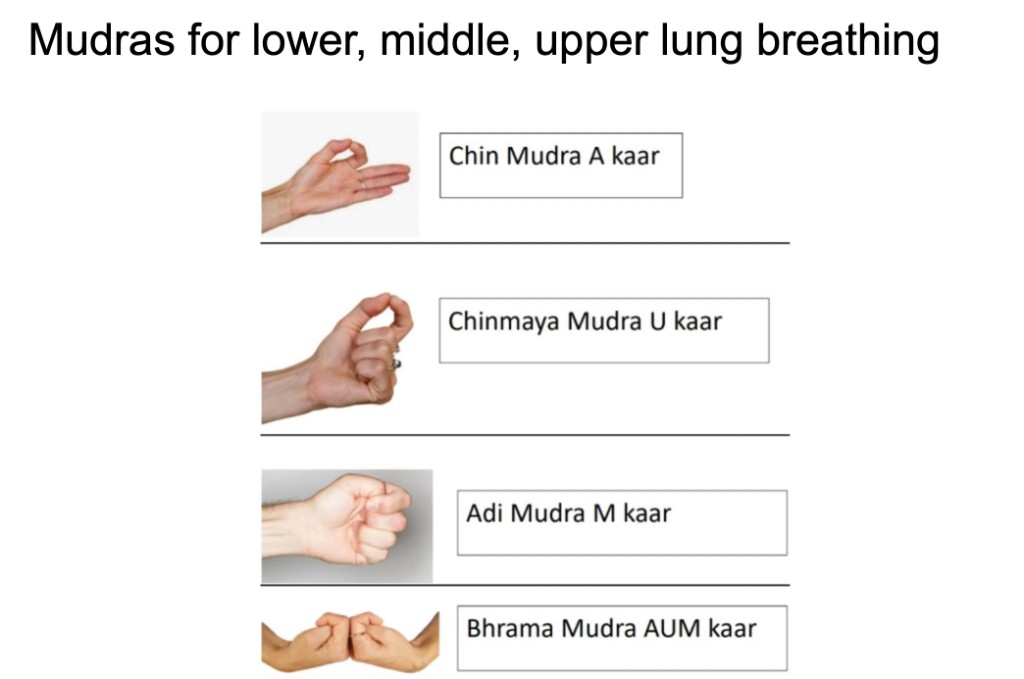
1. Lower lungs — Adham (6 min)
- Mudra: Chin Mudra (thumb + index) on thighs.
- Sound: Soft A (Akāra) on exhale — unforced hum, 3–5 rounds seated.
- Breath: Hand on lower belly; inhale 4 · exhale 6–8 into lower lobes; 6 rounds.
2. Mid-chest — Madhyam (6 min)
- Mudra: Chinmaya Mudra (fingers curled to palms) at heart level.
- Sound: Soft U (Ukāra) on exhale — 3–5 rounds.
- Breath: Inhale into side ribs (hands on lower ribs); exhale 6–8; 6 rounds.
3. Upper lobes — Adhyam (6 min)
- Mudra: Adi Mudra (light fist, thumb inside) at lap.
- Sound: Soft M (Makāra) on exhale — lips closed, vibration in head; 3–5 rounds.
- Breath: Inhale into upper chest/clavicular region (light); exhale 6–8 with M; 4 rounds only — do not strain apex.
Full integration — Pranava flow (included in Phase C time)
Mahat Yoga Mudra / Brahma Mudra: Seated Vajrasana or cross-legged. Both hands in Adi Mudra, knuckles together at navel or sternum (see diagram).
- One slow breath: exhale with A feeling lower lung.
- Next exhale: U — mid chest.
- Next exhale: M — upper/apical.
- One continuous A-U-M on a single long exhale (or three linked exhales) — 3 rounds total, not nine.
Optional transition: brief Dharmika (hands to heart) → Vajrasana → integrated A-U-M. Volume: whisper to soft voice; throat relaxed.
Vagal / HR benefit: Gentle A-U-M resonance + lengthened exhale supports parasympathetic tone — appropriate for lowering resting heart rate over weeks when practiced daily without strain. Track HR before/after weekly; not a single-session fix.
Part 5 — Heart-rate–supporting breath (Phase D · 8 min)
After Pranava, choose one primary plus Apana close. Goal: parasympathetic dominance; not stimulation.
| Technique | Method | When to use |
|---|---|---|
| Extended exhale (default) | Both nostrils · inhale 4 · exhale 8–10 · 12 rounds · no pause | Daily default; shallow breath; HR ~95 |
| Chandra Nadi | Left nostril only · 4:8 · 9 rounds | HR elevated, agitation, or after Pranava feels heating |
| Samana breath | Hand on navel · 4:4 · 12 rounds | Digestive heaviness, bloating, acidity same day |
| Apana close | Belly 4:8 · 6 rounds | Always end Phase D with this |
Optional: Surya Nadi (3–5 rounds, 4:8) only immediately before your walk if legs feel heavy and mind is quiet — see Life Protocol.
Part 6 — Agni mandala / Agni breath (Phase E · 5 min)
Seated. Eyes soft. Attention at navel (Manipura).
- Visualise small red downward triangle — hearth, not bonfire.
- Continuous breath — inhale 4 · exhale 8 (or natural); no kumbhaka.
- Mental RAM on exhale — 5–7 min.
- Discrimination line: “This fire digests food and old stories — and warms the home.”
Agni breath vs Agni mandala: Same hearth intention; mandala emphasises visualization; breath emphasises 4:8 at navel. Use both together here.
Quick reference — breath types in this protocol
| Name | One-line |
|---|---|
| Apana breath | Belly rises 4 · falls 8 · downward release |
| Pranava / sectional | A lower · U mid · M upper · then A-U-M integrated |
| Chandra | Left nostril 4:8 · cooling · HR down |
| Samana | Navel 4:4 · digestive hearth |
| Extended exhale | 4:8 or 4:10 both nostrils · vagal |
| Agni mandala | RAM at navel · red triangle · no hold |
Weekly rhythm
| Day | Practice |
|---|---|
| Mon–Wed, Fri–Sat | Full session map above |
| Thu | Light day: Apana āsana + extended exhale 12 rounds + Agni mandala + settling-thought witness only (~20 min) |
| Sun | Walk + zikr; or Pranava A-U-M × 3 rounds only |
What you may notice (4–8 weeks)
- Breath feels less shallow; occasional awareness of lower, mid, and upper lung filling
- Resting heart rate may trend down (track weekly AM before breakfast — check with your physician if above 100 sustained)
- The busy thought is easier to notice without becoming you
- Life feels more meaningful through Ikigai acts
- Neck and digestion stay comfortable during practice
Related documents
- Life Protocol — Ikigai, home, weekly rhythm
- Pranava Triple-Lobe (general reference)
- Ikigai journey
Your personal protocol · MendOnBend