Pranava Pranayama & Triple-Lobe Sectional Breathing
Through Pranava Pranayama (the A-U-M pattern) together with specific mudras, we can work deliberately through the lower, middle, and upper regions of the lungs while inviting the parasympathetic system to lead—supporting calm, digestion, and recovery. The practice below follows a triple-lobe sectional map: Adham (base), Madhyam (mid-chest), and Adhyam (apex), then integrates them in a full Pranava flow.
The triple-lobe map
1. Lower lungs — the foundation (Adham)
Ground energy in the lower diaphragm—supporting vitality, healing, and immune resilience in the yogic framing of this region.
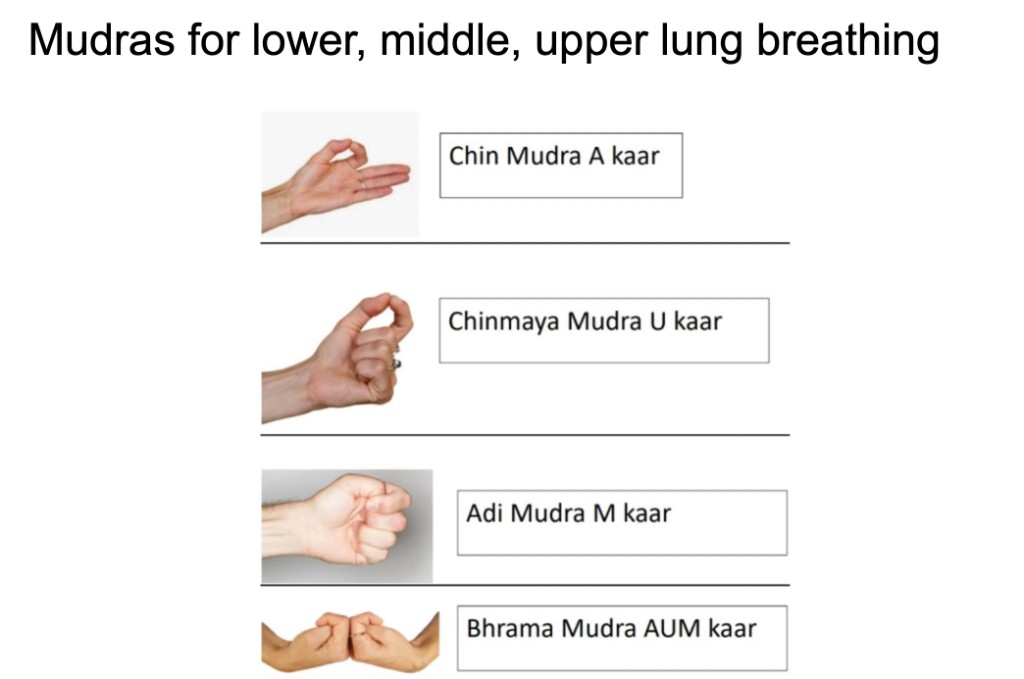
- Mudra: Chin Mudra (thumb and index finger touching) to steady attention in the lower lung field.
- Sound: Akara — the “A” vibration.
- Hathena / asana: Ustrasana (Camel) can help direct breath and awareness into the lower lobes when practiced with guidance appropriate to your spine and neck.
2. Mid-chest — the core (Madhyam)
Shift focus to the thoracic cage—the space of heart expansion and rib mobility.
- Mudra: Chinmaya Mudra (fingers curled toward the palms) to channel attention into the rib cage.
- Sound: Ukara — the “U” vibration.
- Hathena / asana: A Matsya-related kriya or Fish variation—lifting the sternum—to invite the mid-lobes to participate and release stagnation in the chest.
3. Upper lobes — the apex (Adhyam)
Address the clavicular and apical regions, often the most restricted in shallow breathing.
- Mudra: Adi Mudra (light fist with thumb tucked inside) to guide awareness to the upper lung fields.
- Sound: Makara — the “M” vibration.
- Asana: Nikunjasana (heart-to-earth) — from Vajrasana, exhale and bring the top of your head to the floor, bring the upper chest to/towards the floor, finger tips under the head, inhale into the upper lung and turn the head to the right and left with ma kara chanting on the exhalation.
Full integration: the Pranava flow
The A-U-M resonance
The sequence culminates in integrated practice—sometimes named Mahat Yoga Mudra in one lineage; the diagram above shows Bhrama Mudra (paired hands in Adi position, knuckles together) for the full A-U-M resonance—weaving the three sections into one continuous experience across lower, middle, and upper lungs.
From Vajrasana, chant the full A-U-M so that each phase corresponds to the lower, middle, and upper lung regions—letting the sound be steady, unforced, and integrated with a soft belly and quiet face.